Medically Reviewed by Frank Wolf, DDS
The "right" filling material depends on cavity size, tooth location, and how your insurance actually reimburses — not just what looks best. Understanding the structural rules dentists use to recommend crowns, and the long-term consequences of choosing extraction, can save you from unpleasant surprises down the road.
Why Your Insurance Bill May Not Match What You Expected for Composite Fillings
Composite resin has largely replaced amalgam in everyday practice. According to the American Dental Association's MouthHealthy resource, tooth-colored fillings are now used more often than amalgam or gold — largely because patients prefer restorations that blend naturally with their teeth. That preference is completely reasonable. But there's a billing reality most patients don't discover until after treatment.
Many PPO dental plans include what's called a "Least Expensive Alternative Treatment" (LEAT) clause. Under this policy, if your plan considers amalgam the standard of care for a back molar, it will reimburse only at the amalgam rate — even when your dentist places a composite. The difference gets billed to you.
This matters because composite and amalgam fillings carry different ADA procedure codes. A single-surface amalgam on a posterior tooth is billed under D2140; a single-surface composite on the same tooth is billed under D2391. When your plan downgrades a D2391 to D2140 reimbursement, you absorb the gap out of pocket. On multi-surface molar restorations, that gap can be meaningful.
Before your appointment, ask your front desk to run a pre-treatment estimate and confirm:
- Whether your plan applies a LEAT clause to posterior composites
- Which ADA code will be submitted
- Whether the composite versus amalgam difference will be a patient balance
This one conversation prevents billing surprises. It doesn't change which material is clinically appropriate — it just ensures you make an informed choice with full financial context. Your dentist's team can help you navigate this before treatment begins. If you'd like to discover ways to improve your smile with cosmetic dentistry beyond basic fillings, there are many options worth exploring with your provider.
When a Filling Is No Longer Enough: The Structural Case for Crowns
Competing information online tends to oversimplify the crown-versus-filling decision as "small cavity = filling, large cavity = crown." The real threshold is biomechanical.
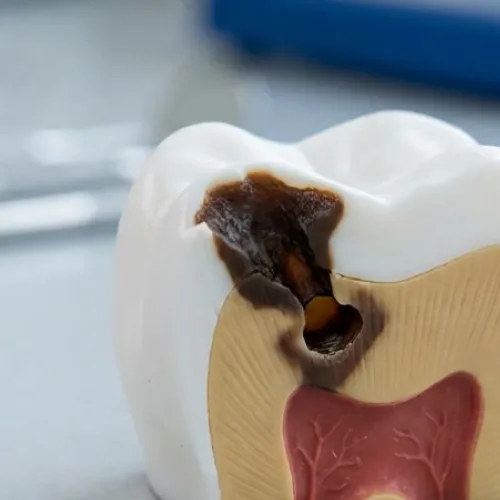
Dentists evaluate whether a filling will hold using what's known as the isthmus width rule. The isthmus is the narrowest bridge of tooth structure between two cusps. When a cavity or old restoration has destroyed more than roughly one-third of that distance, packing more filling material into the space creates a wedge effect. Molars absorb significant biting force — well over 200 pounds of pressure during normal chewing. A large composite or amalgam filling sitting inside a weakened molar acts like a wedge driven into wood: it spreads the remaining cusps apart with every bite. Over time, this produces a catastrophic vertical root fracture. A tooth with a vertical root fracture typically cannot be saved and requires extraction.
A crown, by contrast, wraps around the entire tooth and provides cuspal coverage — distributing force across the whole structure rather than splitting it. As WebMD explains in its dental fillings overview, the location and extent of decay directly influence which restoration is appropriate. When your dentist recommends a crown on a back tooth, they're not upselling — they're preventing a scenario where a compromised filling today leads to an irreplaceable tooth tomorrow. Understanding the many uses of dental crowns can help you see why this recommendation is so often the right call.
A Healthline overview of composite fillings notes that composite is well-suited for small to mid-size restorations. For larger cavities involving multiple surfaces or compromised cusps, the structural argument for a crown is sound and evidence-based. If you have common questions about dental crowns, your dentist can walk you through the specifics of your situation during a consultation.
Filling vs. Extraction: The Hidden Long-Term Consequences
Pulling a back molar to avoid a filling or crown can feel like the simplest solution. It's faster and less complex upfront. But extraction sets off a chain of structural changes that are difficult to reverse.
When a molar is removed and not replaced, the opposing tooth loses its partner and begins to drift out of the socket — a process called super-eruption or extrusion. Adjacent teeth migrate into the gap. Over months and years, this collapses the bite, strains the jaw joint, and creates bone loss in the extraction site. In upper molar extractions, the sinus cavity can expand downward into the space where the root once sat — a process called sinus pneumatization — which complicates any future implant placement.
By the time a patient decides to restore that missing molar, the work required has multiplied significantly. Bone grafting, sinus lifts, and implant placement may all be necessary where a straightforward implant would have sufficed had the tooth been extracted and replaced promptly — or saved with a crown in the first place. Reading a guide to tooth extractions can help you understand what the procedure involves and what to expect if extraction does become necessary.
The National Institute of Dental and Craniofacial Research confirms that untreated decay leads to pain, infection, and tooth loss — and that composite resin materials continue to improve, making restoration more viable than ever. In some cases, when decay has reached the pulp, you may want to discover how you can save your tooth with a root canal before considering extraction as a last resort. Research published via NCBI supports shared decision-making between patients and providers to find the most appropriate restorative approach for each clinical situation.
The takeaway: a filling that preserves a tooth, or a crown that protects it from fracture, is almost always a better long-term outcome than extraction without a clear replacement plan.
Get Personalized Guidance at Hillside Dental Care in Tucson
Choosing between amalgam, composite, a crown, or addressing a tooth differently is a decision that depends on your specific tooth structure, bite forces, and insurance plan. Hillside Dental Care serves patients throughout Tucson and Southern Arizona with honest, thorough treatment planning. It's also worth knowing that routine prophylaxis cleanings are vital for your oral health and can help catch decay early before more extensive restorations become necessary. Contact our team to schedule a consultation and get a clear picture of your options before committing to any procedure.
Medical disclaimer: This article is intended for informational purposes only and does not constitute professional dental or medical advice. Always consult a licensed dentist for diagnosis and treatment recommendations specific to your situation.


























DENTAL CARE TEAM Tucson, AZ
OUR SOCIALS
Check us out and follow our accounts on the following social media platforms